
What Is AI Automation for Business?
Separate deterministic automation from AI judgement and choose a bounded pilot with measurable risk controls.
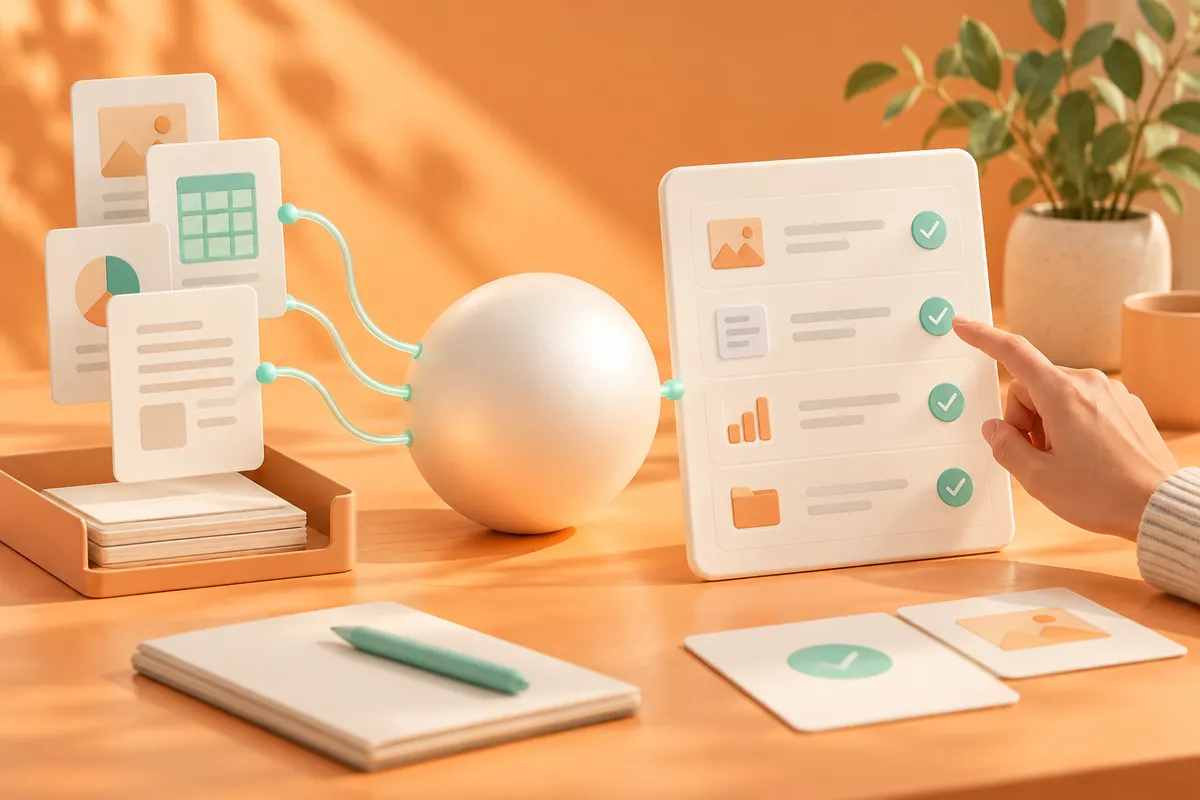
AI automation combines a business workflow with a model that interprets or generates information. The model might classify an enquiry or draft a reply; ordinary software still handles permissions, validation and record updates. A useful system makes clear which decisions are deterministic and which may be uncertain.
Choose a task with a reviewable output
Good early candidates include summarising an internal note, proposing an enquiry category or drafting a response from approved material. These outputs can be checked before they affect a customer. Avoid starting with unrestricted access to payments, customer records or outbound communications.
For example, a hypothetical sales team could ask a model to suggest a category and owner for an enquiry. A rules engine checks that the owner exists, and a person approves ambiguous cases. This illustrates an approach, not a claimed client deployment or an expected saving.
Understand the failure modes
A plausible response can still be wrong. Untrusted customer text may contain instructions designed to manipulate a model. Limit what data and tools the model can access, validate structured outputs and keep secrets outside prompts. Treat model-generated text as a proposal, not privileged instructions.
Design a safe operating boundary
- Define allowed inputs and the smallest necessary dataset.
- Restrict tools to specific actions and enforce permissions outside the model.
- Require approval before consequential changes or messages.
- Log outcomes without unnecessarily exposing personal information.
- Provide a manual queue when the model or integration fails.
Measure useful outcomes
Compare a sample of outputs against agreed criteria: correct classification, unsupported statements, escalation rate and time spent reviewing. Include the cost of checking and correcting mistakes. A faster first draft is not the same as a faster completed business task.
Decide whether AI is needed at all
If the task is a stable rule such as assigning a lead by branch postcode, conventional automation may be easier to explain and test. Use AI where interpretation creates a demonstrable benefit. Workflow automation versus agents helps choose the appropriate level of autonomy.
Sources & further reading
Examples and decision frameworks are planning guidance, not guaranteed outcomes. Check current provider requirements before implementation.
Related articles
View all →
AI & Automation
10 Business Processes You Can Automate
Ten candidate workflows, with triggers, human checkpoints and a method for choosing the first pilot.
2 min read
AI & Automation
How to Connect LINE Official Account with Your CRM
Plan a secure LINE Messaging API integration with verified webhooks, identity linking, deduplication and support ownership.
2 min read
AI & Automation
Workflow Automation vs AI Agents
Choose deterministic workflows or bounded agents by predictability, tool permissions and the cost of a wrong action.
2 min read