
Custom CRM vs Off-the-Shelf CRM
Compare workflow fit, implementation effort, ownership, integrations and the practical cost of changing systems.
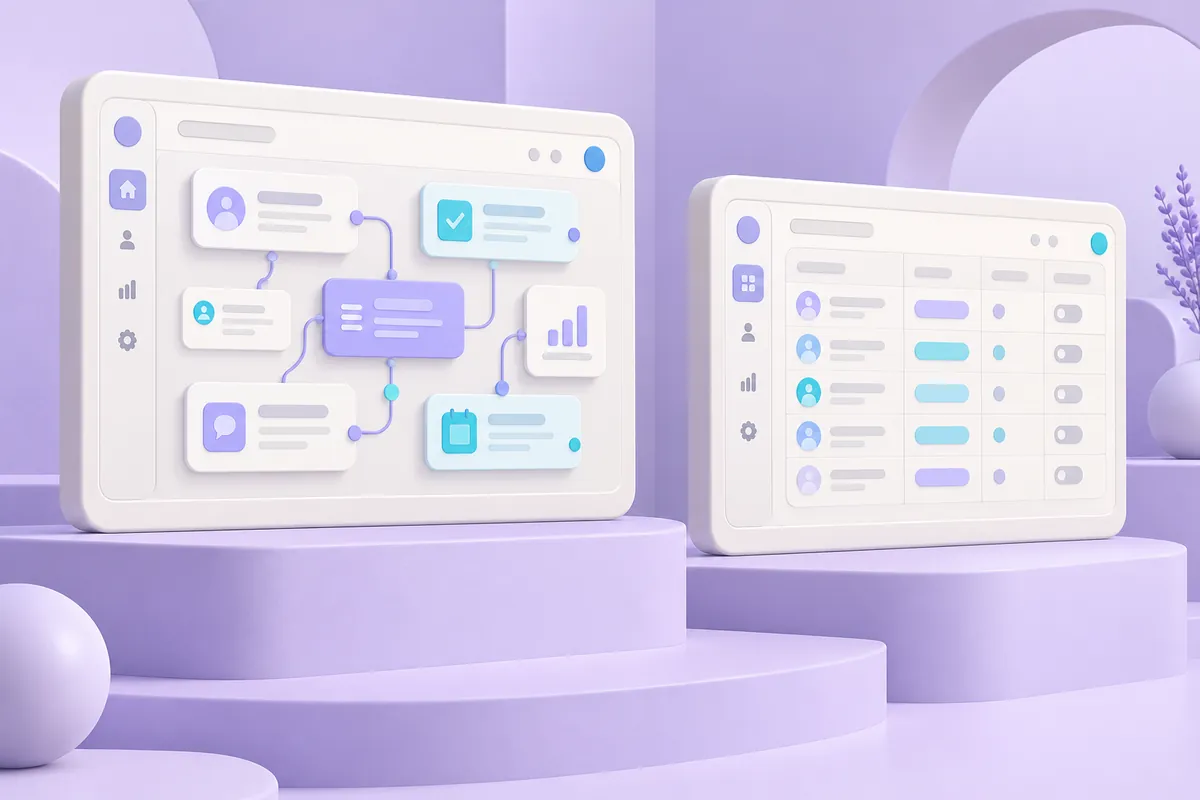
Choose a ready-made CRM when its core workflow fits and your team can work within its constraints. Consider a custom CRM when a business-critical process cannot be supported well through configuration or a modest integration. Neither route automatically delivers better adoption.
Compare a real scenario, not feature lists
Ask each option to handle the same example: two branches sharing one company record, separate opportunity owners and restricted financial fields. Include a quotation revision and a customer reassignment. Record which steps are native, configured, integrated or manually duplicated. A successful sales demonstration is not evidence that all permissions and edge cases work.
Understand what you will own
| Question | Ready-made CRM | Custom CRM |
|---|---|---|
| Who controls the core product roadmap? | The vendor | Your organisation and delivery team |
| How are changes delivered? | Configuration, extensions or vendor releases | Planned engineering work |
| Who handles platform maintenance? | Depends on the contract and hosting model | Must be explicitly assigned |
| Can you leave? | Test exports and integration limits | Agree code, data and deployment handover |
These are evaluation questions, not guarantees about a particular product. A custom build can still depend on licensed services; a packaged platform can still offer substantial configuration.
Compare total operating effort
Include setup, migration, subscriptions or hosting, integration maintenance, staff training and future change requests. Ask who responds when a synchronisation fails and whether support includes restoring data. Avoid comparing a subscription price against only the initial custom-development invoice.
Prefer the smallest justified exception
A hybrid may fit: keep a standard CRM and build a separate portal or integration for a genuinely distinctive process. Check whether this creates duplicate sources of truth. Identify which system owns a contact, opportunity and invoice before connecting them.
Make the decision reversible
Pilot with a small team and sample data. Define acceptance criteria and test exports before committing the whole business. Choose based on the bottleneck you can demonstrate, not the promise of unlimited flexibility. Use our CRM cost planning guide to compare proposals on equivalent scope.
Sources & further reading
Examples and decision frameworks are planning guidance, not guaranteed outcomes. Check current provider requirements before implementation.
Related articles
View all →
CRM & Sales Systems
What Is CRM? A Complete Guide for Growing Businesses
Understand CRM, choose useful features, and plan a rollout around customers, ownership and measurable sales work.
3 min read
CRM & Sales Systems
CRM for Small Businesses: How to Get Started
A small-team CRM rollout: choose a narrow process, clean useful data, assign ownership and test daily adoption.
2 min read
CRM & Sales Systems
How Much Does Custom CRM Development Cost?
Build a defensible CRM budget from scope, migration, integrations, risk and ongoing ownership—not a headline price.
2 min read